AI literacy and competency: The key to workforce readiness
What AI skills do students need to thrive in a rapidly changing workforce and how are institutions embedding these competencies?

Image courtesy of BETT
9 February 2026
The demand for AI skills across the globe has skyrocketed. In the UK, the latest EIT tech talent report shows a 120% increase in job postings requiring generative AI expertise.Across Europe, the numbers are even more significant, with Ireland seeing a 204% increase, and Germany and France 109% and 91% respectively.Employers expect graduates to now enter the workforce with AI literacy as a baseline competency, not a niche skill. The role of higher education (HE) in accelerating student readiness has never been so important.A panel at BETT, moderated by Lenovo’s worldwide education senior strategist, Delia DeCourcy, shared insights on AI skilling needs, innovative programmes, and strategies that are helping students succeed in a volatile job market.On stage were Helen Crompton, professor of instructional technology, Old Dominion University; Christie Pritchard, associate dean of education and student experience, University of Plymouth; and Larry Rother, global director for the public sector at Intel to debate opportunities and challenges.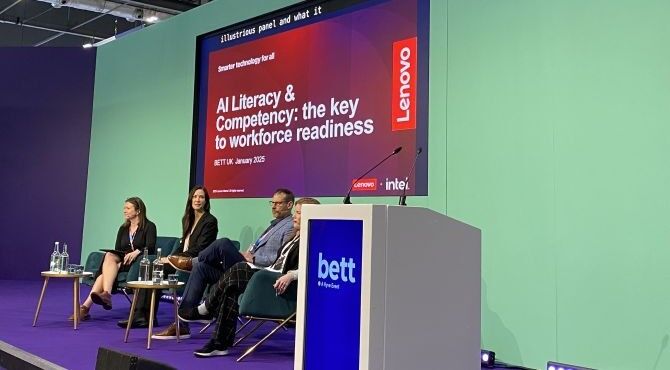 Industry and academia discuss AI workforce readiness at the recent BETT UK conference


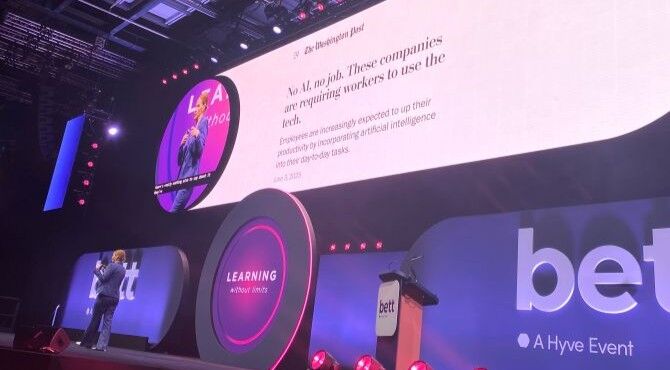 Other talks at BETT explored workforce trends in an AI-driven world
Don’t miss further coverage of BETT in the Education sections of our websites relocateglobal.com and thinkglobalpeople.com.

Subscribe to Relocate Extra, our monthly newsletter, to get all the latest international assignments and global mobility news.Relocate’s new Global Mobility Toolkit provides free information, practical advice and support for HR, global mobility managers and global teams operating overseas.
Industry and academia discuss AI workforce readiness at the recent BETT UK conferenceA 2030 jobs outlook
Describing the current “dysfunction in the workforce” - De Courcy helped set the stage for the discussion.“There has been a massive change over the last few years with the number of jobs in increasing demand and the skills that are required for those jobs, versus a decrease in demand and the automation we are seeing across several industries.”In addition to the uncertainty and AI’s total disruption of the workforce, is this huge economic opportunity.“It’s predicted there will be a $15.7 trillion increase in global AI-related GDP growth in five years – that’s a huge number,” said De Courcy.“We’re thinking about how AI is affecting the workforce and in which ways. Is AI commoditising intelligence? Just think about that from a resource perspective,” asked Rother.“When we’ve commoditised resources, made things that were once scarce become abundant, and things that were expensive more accessible – usually, if you think about energy or water, the human race benefits. So we’re looking at workforce readiness from this context.”Rother explored whether AI is commoditising intelligence differently from the way the internet commoditised information and if we are truly at a stage where AI has become cheap and accessible to all.With the shape of the future workforce in mind, he talked through a 2030 jobs outlook chart by the World Economic Forum, detailing the fastest growing and declining jobs.Among the fastest growing jobs were big data experts, fintech engineers, AI and machine learning specialists, software and application developers, security management specialists, UI and UX designers and autonomous and EV specialists. Roles in decreased demand included accountants, data entry clerks, secretaries, cashiers and many logistics and transport roles.“A very small percentage – about 2% of the jobs, even in the tech industry, come under AI development and research,” said Rother.Where most of the AI jobs fall and where Lenovo is focused, is on upscaling HE and the workforce to become what Rother calls ‘AI solution builders’.“By that, I mean people that have a deep AI knowledge, who can create with AI to solve industry problems. People who know how to modify an AI tool, LLM or automation and can improve performance.”A large bulk of the workforce will also be what Rother calls ‘AI power users’.“AI power users are people who have a deep understanding of commercially available AI tools and can use those to solve problems in the workplace. So for us, as we look at higher education, it’s about training the largest portion of the future workforce to engage with AI and make the most impact.”The role of higher education
Given the change in workforce demands and the skills required, De Courcy asked what the priorities for HE were, and how institutions were meeting the moment.Getting students ready in this new frontier has its challenges, especially for HE.While productivity and economic value remain strong drivers for industry, both Pritchard and Compton stressed the need for students to fully understand AI and related technologies.“I think there’s a big discrepancy between what we need in HE and what we need for the workforce. In HE we want students to learn the skills (not just AI skills) and then be able to use these skills. We want them to know all the content and understand it so when they go into the workforce they know what they’re talking about,” explained Crompton.Crompton added that part of HE’s role to prepare students for success means they must be fully confident in their AI literacy. Including knowing where and when to use AI, its wider implications and how to use it effectively.“You can use AI to quick skip ahead and do certain things but how does that person know that AI has done the right thing? That’s where in education, we really need to teach students.”Related reading
- BETT 2026: Learning without limits
- The path to AI empowerment
- The Future of education: Balancing innovation, inclusivity and wellbeing
Future-proofing thinking
Crompton and Pritchard detailed how they are preparing students within their areas of work.“I think it’s also about what we want our graduates to be able to think. It’s not what we want them to know – that’s moved on. The question is now how do universities use AI to enrich their learning? How do we teach them the safety rules for the AI we have now? Because that’s going to change again too.”AI readiness requires the sharpening of many human skills alongside it.“We have to future-proof their ways of thinking, their ways of knowing and their ways of critiquing the AI as well – in terms of when not to use it,” added Pritchard.She noted that with students more pressed than ever – for time, money and the ability to engage with HE, the importance of getting the right balance on AI use is essential.“We don’t want them to use AI to outsource all tasks, and we [educators] shouldn’t be using AI to outsource tasks where we need to be involved. Setting the right landscape is important.”AI presents a chance to shake things up in HE too. ‘There is an opportunity here to actually rethink and redesign education,’ said Pritchard.She implied that AI has in some ways exposed some things that were already wrong with HE and that we need to think how we reshape the curriculum and imagine what the next 5-10 years will look like.Panellists discussed how students should have a say in their education and work readiness, particularly on how they want to learn and how they want to be assessed.Other talks at BETT explored workforce trends in an AI-driven worldDigital literacy, AI usage and empowerment
The panel explored how institutions more broadly are preparing students for the future of work, from updating programmes to certifications, credentialing in-demand skills and integrating AI.Other topics included the appropriate level of AI usage. Crompton voiced her concerns that many students still feel worried about using AI and it being considered ‘cheating’. Adding that policies needed to inform and empower students on AI use to avoid any fear and confusion.Pritchard also shared research showing how some students create their own moral code when it comes to AI use and that many want to learn and understand things, so educators shouldn’t start from a place of mistrust.According to Rother, worries around AI use are less reflected in the business world. “We talk to businesses and they’re not concerned about employees using AI or doing tasks faster at all.”But the panel agreed concerns still remain around ethics and privacy for both private and public sectors. Panellists also talked about the importance of public-private partnerships to accelerate workforce readiness and help close the AI skills gap.Crompton shared a useful European competencies framework – Dig Comp 3.0 – to help educators, learners, organisations and employees use AI and all digital systems and technologies effectively.‘AI washing is a term I’m sure we’re all familiar with. AI is being thrown everywhere – with all sorts of different skills but the AI literacy we need now goes back a long time – it’s digital literacy.”Putting the often alarming statistics around AI workforce readiness, job security and reskilling into perspective, she added: “The issues we have now like data privacy, security, and knowing how to use these tools effectively, many of these all go back to the internet.”The future of jobs in numbersTop skills in demand include AI and big data, networks and cybersecurity and technology literacy.170 million - the amount of roles created by increasing demand of new skills92 million - the amount of roles displaced by decreasing demand of existing skills39% - the number of key skills required in the job market that will change by 2030Source: World Economic Forum, The Future of Jobs 2025 report |

Find out more about the Think Global People and Think Women community and events.
Subscribe to Relocate Extra, our monthly newsletter, to get all the latest international assignments and global mobility news.Relocate’s new Global Mobility Toolkit provides free information, practical advice and support for HR, global mobility managers and global teams operating overseas.
©2026 Re:locate magazine, published by Profile Locations, Spray Hill, Hastings Road, Lamberhurst, Kent TN3 8JB. All rights reserved. This publication (or any part thereof) may not be reproduced in any form without the prior written permission of Profile Locations. Profile Locations accepts no liability for the accuracy of the contents or any opinions expressed herein.