Building students for an AI-driven workforce
AI is transforming the way we live, learn and work, creating opportunities and challenges for education systems worldwide. We went to hear how countries are preparing students at scale.

Robots at work on the conference floor. Image courtesy of BETT
13 February 2026
Equipping students for an AI-driven workforce requires action at every level, from national policy to curriculum, teaching and learning environments.At the latest BETT conference, education ministers, policymakers and educators from Canada, US, Central Asia and Europe shared how they are working to build AI literacy and digital skills.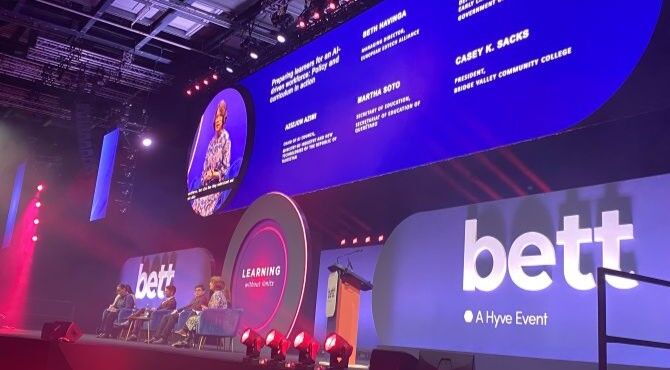 On preparing students for an AI-driven workforce, priorities and challengesAzizjon Azimi: Tajikistan has positioned itself as an AI leader. We have a national AI strategy and have become a sort of nexus for central Asia on AI – a region that is seeing rapid growth.Our vision is centred on the fact that we’re bringing AI as a mandatory school subject to each one of our two million school children in the country, across 4,000 schools. Currently that subject is rolled out as an elective in 100 schools and we’re designing this programme with the full support of our president.The key focus is that every school child has to be AI literate. This is an absolute must in an age where you see this level of automation that is coming up across different modes of machine learning, deep learning and computer vision. The introductory AI school subject is to equip students with a solid basic understanding of AI and related technologies. It covers things like: How does an LLM work? What is a transformer? How can you play around with computer vision to do good, or how to identify deep fakes?The second goal on a national level is to create a pipeline for training the next generation of machine learning and deep learning engineers. If two million students learn about AI at a school level and understand the fundamentals, we’re later looking at about 20,000 engineers that can be trained locally.Some might well be students with strengths in computer science and maths who can easily pivot to AI because that’s where we see most of the value add. So we’ve balanced this idea of being a leading AI literate nation, with growing tens of thousands of new engineers that we can train locally to do AI exports.Ryan Donaghy: We too have looked extensively at AI literacy. The skillset we need to impart to our students has changed but our system hasn’t changed a lot over the last 150 years. For us it’s about how do we move from just the foundations, to ensuring our students are leaving with the ability to critically think and assure the quality of what is being given to them from the machine.By September, we will have AI literacy across our curriculum from K12 in all schools in the province. We've also developed a framework two years ago that we’re already updating because things are moving and changing so rapidly. That framework doesn’t chase the next shiny object, or focus on chasing any one piece of technology.We have purposely decided to give our teachers agency. This allows them to really think through a piece of technology or a new AI tool and whether it’s going to be best for their classroom or their particular group of students. They’re also thinking about factors such as data privacy to make a decision that fits. We do have some tools that are pre-approved but they’re not limited to them.The experiential learning component to AI teaching and learning today is so critically important too. We have to give our students the ability to try it, to do things by trial and error and give psychological safety to both students and teachers to try and fail and decide for themselves whether they are not going to do something.It’s a new way of thinking that we really need to encourage if we’re going to continue to move at the speed of AI, or catch up to it.Martha Soto: In Mexico, we really depend on our national government. Our first challenge – is the fact that our education curriculum is set at a national level and as a sub-national government we don’t have much influence on the design of the curriculum that we teach.Our national education curriculum was updated two to three years ago but unfortunately AI has not been included in it, not as an education subject or even as a tool. So although we have made progress, AI has not been sufficiently included as part of those changes. In the state of Querétaro, finance and resources are also an issue.In these types of discussions, I often hear that it’s students who don’t understand AI. I think it’s actually the teachers who don’t understand how to use AI. We need to use AI right across education – for tests, assessments and research. We also need to use public policy as a tool to help teachers overcome their fear of using AI.Casey K. Sacks: As a practitioner, I worry about two different factors. There is certainly the teaching and learning piece. For instance, how we help our students get equipped with new technologies and understand them in their learning. It’s also about how we help prepare the workforce of not just tomorrow, but of today.In every single industry sector, from healthcare to manufacturing and IT there are AI skills that need to be immediately applied. The workers I most want to hire as an employer are people who can figure it out. People who are willing to adapt and experiment and who are able to take the technology in their stride and say – oh, we use AI now to chart in healthcare.If you’re a nurse and you go through our nursing programme, you go into a clinic and into a client room and have conversations with AI doing all of the charting. This really helps our nursing facility to understand how to immediately upskill people because those hospitals are not going to wait until schools are ready with their curriculum. The hospitals are already using AI for medical charting.Our challenge as educators is that we also need to prepare students for work as it is right now, and we need to think about how those things intersect in an intentional way.


Don’t miss further coverage of BETT in the Education sections of our websites relocateglobal.com and thinkglobalpeople.com.

Subscribe to Relocate Extra, our monthly newsletter, to get all the latest international assignments and global mobility news.Relocate’s new Global Mobility Toolkit provides free information, practical advice and support for HR, global mobility managers and global teams operating overseas.
The panel
- Ryan Donaghy, Deputy Minister of Education and Early Childhood Development, Government of New Brunswick, Canada
- Azizjon Azimi, Chair of AI Council, Ministry of Industry and New Technologies, Tajikistan
- Casey K. Sacks, President, Bridge Valley Community College, USA
- Martha Soto, Secretary of Education of the State of Querétaro, Mexico
On preparing students for an AI-driven workforce, priorities and challengesAzizjon Azimi: Tajikistan has positioned itself as an AI leader. We have a national AI strategy and have become a sort of nexus for central Asia on AI – a region that is seeing rapid growth.Our vision is centred on the fact that we’re bringing AI as a mandatory school subject to each one of our two million school children in the country, across 4,000 schools. Currently that subject is rolled out as an elective in 100 schools and we’re designing this programme with the full support of our president.The key focus is that every school child has to be AI literate. This is an absolute must in an age where you see this level of automation that is coming up across different modes of machine learning, deep learning and computer vision. The introductory AI school subject is to equip students with a solid basic understanding of AI and related technologies. It covers things like: How does an LLM work? What is a transformer? How can you play around with computer vision to do good, or how to identify deep fakes?The second goal on a national level is to create a pipeline for training the next generation of machine learning and deep learning engineers. If two million students learn about AI at a school level and understand the fundamentals, we’re later looking at about 20,000 engineers that can be trained locally.Some might well be students with strengths in computer science and maths who can easily pivot to AI because that’s where we see most of the value add. So we’ve balanced this idea of being a leading AI literate nation, with growing tens of thousands of new engineers that we can train locally to do AI exports.Ryan Donaghy: We too have looked extensively at AI literacy. The skillset we need to impart to our students has changed but our system hasn’t changed a lot over the last 150 years. For us it’s about how do we move from just the foundations, to ensuring our students are leaving with the ability to critically think and assure the quality of what is being given to them from the machine.By September, we will have AI literacy across our curriculum from K12 in all schools in the province. We've also developed a framework two years ago that we’re already updating because things are moving and changing so rapidly. That framework doesn’t chase the next shiny object, or focus on chasing any one piece of technology.We have purposely decided to give our teachers agency. This allows them to really think through a piece of technology or a new AI tool and whether it’s going to be best for their classroom or their particular group of students. They’re also thinking about factors such as data privacy to make a decision that fits. We do have some tools that are pre-approved but they’re not limited to them.The experiential learning component to AI teaching and learning today is so critically important too. We have to give our students the ability to try it, to do things by trial and error and give psychological safety to both students and teachers to try and fail and decide for themselves whether they are not going to do something.It’s a new way of thinking that we really need to encourage if we’re going to continue to move at the speed of AI, or catch up to it.Martha Soto: In Mexico, we really depend on our national government. Our first challenge – is the fact that our education curriculum is set at a national level and as a sub-national government we don’t have much influence on the design of the curriculum that we teach.Our national education curriculum was updated two to three years ago but unfortunately AI has not been included in it, not as an education subject or even as a tool. So although we have made progress, AI has not been sufficiently included as part of those changes. In the state of Querétaro, finance and resources are also an issue.In these types of discussions, I often hear that it’s students who don’t understand AI. I think it’s actually the teachers who don’t understand how to use AI. We need to use AI right across education – for tests, assessments and research. We also need to use public policy as a tool to help teachers overcome their fear of using AI.Casey K. Sacks: As a practitioner, I worry about two different factors. There is certainly the teaching and learning piece. For instance, how we help our students get equipped with new technologies and understand them in their learning. It’s also about how we help prepare the workforce of not just tomorrow, but of today.In every single industry sector, from healthcare to manufacturing and IT there are AI skills that need to be immediately applied. The workers I most want to hire as an employer are people who can figure it out. People who are willing to adapt and experiment and who are able to take the technology in their stride and say – oh, we use AI now to chart in healthcare.If you’re a nurse and you go through our nursing programme, you go into a clinic and into a client room and have conversations with AI doing all of the charting. This really helps our nursing facility to understand how to immediately upskill people because those hospitals are not going to wait until schools are ready with their curriculum. The hospitals are already using AI for medical charting.Our challenge as educators is that we also need to prepare students for work as it is right now, and we need to think about how those things intersect in an intentional way.Read related articles
- AI literacy and competency: The key to workforce readiness
- BETT 2026: Learning without limits
- The path to AI empowerment
- The Future of education: Balancing innovation, inclusivity and wellbeing
On shaping AI policy and approaches to education
Ryan Donaghy: Our approach is not a spotlight-type approach, or focused on being able to only use one type of technology. We really did a framework so that we are judging technology before it enters the classroom and the teachers then have the agency as to what they’re going to choose to use.We have a high level framework but a lot of guidance documents have been created too. Not just for administrators, teachers and students but for families too. Because if families can’t help in the educational journey of their student that’s only going to be an added challenge, so we try to give all the tools that are available to us.Casey K. Sacks: We started from the US government’s AI documents and then worked with our faculty to think about what we need in a more practical sense to meet the needs of employers. We started talking to big employers in the region and for us those are in manufacturing, IT and healthcare – so in terms of implementation it’s been more of a business use case.Our teachers spend some time out every week with employers like Toyota, a big manufacturer in the region. It’s a plant we’ve all visited many times and that’s an important function because you need to see what the automation looks like. You need to know what developments are being made and what’s going on with the robots.We’ve modelled one of our manufacturing labs to look exactly like Toyota because we want our students to learn in a very authentic environment. It’s an important part of their real-world learning.Azizjon Azimi: Our approach on a national level is very libertarian when it comes to AI regulation. Right now, our country is passing and adopting the world’s first AI free zone, where companies who are doing frontier research are able to operate under a AI self regulation mandate which allows for very quick pilots. Companies like Perplexity AI, SuperMicro and Cerebras enjoy that free zone.We have also developed our own local large language model – SoroLLM, designed to serve Central Asian languages and has been fine tuned to our local education system to help bridge the gap left by English-dominated AI models.One of the key aspects of our broader AI strategy is that every problem opens up an opportunity. We have the highest level of government support due to a very ambitious national aim for 5% of GDP to be from AI-related activity by 2040. The entire economy is changing. We don’t see challenges ahead – just opportunities.Don’t miss further coverage of BETT in the Education sections of our websites relocateglobal.com and thinkglobalpeople.com.

Find out more about the Think Global People and Think Women community and events.
Subscribe to Relocate Extra, our monthly newsletter, to get all the latest international assignments and global mobility news.Relocate’s new Global Mobility Toolkit provides free information, practical advice and support for HR, global mobility managers and global teams operating overseas.
©2026 Re:locate magazine, published by Profile Locations, Spray Hill, Hastings Road, Lamberhurst, Kent TN3 8JB. All rights reserved. This publication (or any part thereof) may not be reproduced in any form without the prior written permission of Profile Locations. Profile Locations accepts no liability for the accuracy of the contents or any opinions expressed herein.